Sunday, July 12, 2015

Banded Clinging Crab

Banded Clinging Crabs (Mithraculus cinctimanus) don't intentionally prey on but algae, particles of organic matter, and mucus ejected with the anemones digested food. Their blunted chela are adapted to to scraping algae and mucus from coral. These crabs are covered in buildups of calcium carbonate and red algae that serve as very good camouflage.


7.10
Ah a hike. Which was much easier than the first time because of the fact that I took my inhaler, but due to the calf cramps and the slight back cramps it took me a bit longer to get over there, so Thomas helped me out and he told me about hearthstone and guildwars.
Once we got over there both of us immediately began to pick up trash. Once we were all filled up on trash, we headed back on the "schoolbus" and I begrudgingly took a five minute break. After that I went out in the water and was able to find a couple locations and take some measurements for my project on the dive slate. While out there I was having a little trouble, because things would come up from my throat/stomach and my body was just so angry with me for so many reasons. But, being the stubborn idiot I am, I ignored it as well as the awful taste in my mouth.
I was able to find the 3 species I had found before, and the blues were in the most abundance. (SOO CUTE and POKEABLE.) After helping Codeee with her measurements, we headed in.
(Skip lunch which I did eat, but I still wasn't feeling too well.)
After lunch I took a 5 minute kayak out around just to go somewhere in it. And then shower.

Now cue the lovely downpour.
(SIDE NOTE ABOUT THE NIGHT SWIM THAT I DIDN'T INCLUDE A FEw DAYS AGO PROBABLY- It was so fun! People got stung by jelly fish while Codee and I were laughing our butts off looking at all of the nightlife. There were SO MANY JELLYS. I loved even the slightly scary parts. We didn't swim with any spotted eagle rays, but we did find a spotted sand ray ish thing which was super cool!)
Now din dins and then soon lecture on Annelids and Sipunculids and mites and leeches and organs and worms. 
-Olivia Van Housen

Crab Coition

Interrupted these fellows on the way up to my room last night.

Saturday, July 11, 2015

Acclimation to the Island Environment

             Just want to point out how much I've been able to learn and observe on the trip!! I definitely feel the effectiveness of the immersion model of this class. Reading and learning the material in a class and a lab offers one perspective, however having visual and tactile experience to associate the labels and terminology with makes the learning process almost instantaneous! I feel very fortunate to be on this trip and to gain all of these experiences.

            On another note, the change of pace that the island atmosphere provides is much needed for me. In the setting I find it much easier to live in the moment and to set clear objectives and goals for the day. I have also had some eye opening experiences in terms of seeing how comfortably people can survive with minimal resources. The native Hondurans in the East Village of the island are some of the friendliest people I have ever had the pleasure to meet, while living in poverty with minimal resources. Their ability to form a stable and happy community in the face of adversity and without support form the unstable Honduran government serves as a source of inspiration to me, and exemplifies that notion that hardship is relative and everyone has the potential to overcome.

We have what living in our bodies?

 After getting back from Chachahuate and doing an intense garbage cleanup in the East End village this morning, I was finally able to get into the water to work on my project. Our project is taking a deeper look into the role algae has in the ecosystem. The main factors we are looking for are: whether or not increasing depth effects the organisms around the algae, whether or not more algal cover effects organisms around the algae, and whether or not there is a correlation between parasitic associates and algal development. I did a focal area sampling today of a shallow algae area. Thomas is going to do a deep one tomorrow. I took pictures and noticed that there were relatively few organisms eating the algae at this depth. We will later analyze the percent algae cover, and compare the results with sampling at greater depths. I then took a sample of the algae and we will analyze it under the microscope tomorrow. Yesterday, after analyzing our algae from that day, we saw at least 3 parasitic associates on every alga! We are trying to figure out exactly what they are called and how they correlate with the algae, but some of them are big and very lively (which we defined as moving from one significant part of the algae to another). Each algae sample that we looked at was only about a few centimeters long, yet there was another life living on it that one just can’t see. Dr. Gilchrist actually gave us a lecture after dinner today about worms, which related to our project. We discussed annelids and sypunculids and found out that we most likely have been seeing macrophagous feeders (on our algae). These are known to eat algae, seagrass, and other plants. One interesting fact that I liked about both types of worms is that they have a “straight through” gut – meaning they have 2 openings in their body (mouth and anus). This gives them an advantage over other organisms that are more complicated. Dr. Gilchrist said that the types of experts in sypunculids can be counted on one hand! She then got into the details about worms – specifically parasites. Apparently, we all have about 4 different types of species in our bodies. Many of them surround and roam our intestines. They usually get in through normal activity, especially drinking tap water and wearing no shoes (which many of the New College students do) can invite parasites into our bodies. Nothing out of the usual, just a bunch of parasites roaming our internal organs. To conclude the night, everyone asked Dr. Gilchrist about how we can get rid of these parasites that are apparently in our body. 


Friday, July 10, 2015

The beginning of the stupendous starfish project


Hi guys! I just wanted to give you a little preview of my project. The purpose of my experiment is to test how the size, the depth, of a starfish, as well as the long shore currents verses the currents further out affect the amount of time it takes for star fish to flip over. This project is important because when a starfish is on its back they are left defenseless against their predators and their survival is left at a the chance on whether or not a predator is near by. Here are some really cool pictures of this process. ( I took them and Tomas edited them.) I hope you think they are as awesome as I do. 


Arthropod Appeasement


Red Rock Crab
Grapsus grapsus
Munching on another crustacean

Blue Land Crab
Cardisoma guanhumi
Eating a fallen hibiscus flower

Thursday, July 9, 2015

July 7

Today we started our independent research projects. I have decided to study flamingo tongue snails and their relationship to the common sea fan. On the reef there are many of these mutualistic relationships and I wanted to conduct something that is abundant to assure the most challenging aspect is not finding the species. I am looking at how much the snail eats in area per day per centimeter of snail. The feeding trail of the snail can be seen as the coloration is distinct on the sea fan. I am going to try and use a computer program to find the are of the spot eaten, as Professor Gilchrist told me about it. The only problem is she forgot the name of the program. I am going to spend some time poking around the internet later to figure out a program that will work, at least I know there is one out there. 

In the field, I went and marked 10 different fans I will look at everyday. That way I can track the change per day and find and average for each snail. It was a lot harder than I thought to physically place the flags. Originally, I was going to do half of my flags deep and half shallow but I quickly learned shoving a flag into the sand/rock was hard enough in shallow water. I used a combination of different rocks and things to keep the flags to stay put. We will see if I was successful tomorrow...


The snails stay for a while, and if one moves one day I can choose another one and just go with the numbers I already have for a data point. With that said, I am prepared to change my question and direction of my project based on what I see in the field, as I think that is a big learning objective of field study it self. I am very excited to get to do something hands on and real and completely led by my own decisions. 


Tomorrow's plan is to start taking pictures to be analyzed as well as measure each snail.


7.7

This moring we were able to go out and take a quick walk over to the edge by the firepit. There Dante showed us a beautiful looking fish. (Furiously looks up fish type) (Catches humming bird and then it escapes and then finally leaves the hang area) So I couldn't identify the fish because I was forgetting what type it was. And we also saw an EEL. A chain eel!!!! 

Moving on. 

I'm planning my research project on hermit crabs and where they reside, what types are out there, (4 types according to Dr. Gilchrist) and what coral type they prefer. It seems pretty straightforward. If I'm not able to have a semi-successful first day, I will change my idea to parrotfish coral preference, like which corals do the stoplight parrotfish eat most, etc.

Who knows. I need to get out there ASAP to do some work. But until then....

(Skip making two AWESOME coconut rings)

(Skip tasty pizza)

I went out to swim to look for hermit crabs and the boys (Thomas and Adam) roped me into going with them to explore. While they swam around I poked a couple hermit crabs and identified mostly the Dwarf Blues. Some stayed in the fire coral so I was not able to identify them.

After that was din dins and lecture time. The day ended with Natalie, Codee, Thomas, Mei-Jing, Grace, and I numbering and gluing shells for Dr. Gilchrist. It was a pretty lovely day. Before bed I read to Codee some common Spanish phrases and some things about corals in a funny voice that was very entertaining. 
-Olivia Van Housen


Wednesday, July 8, 2015

Snorkeling for Symbiosis

This marks day two of our individual research projects. I set out today with the goal of finding the remaining two Giant Anemones that I will be studying. It only took me a few minutes to locate the area I was working in yesterday. After flagging the remaining two, I started photographing the anemones I will be studying. I was careful to not kick my flippers too close to the anemones to avoid disturbing any organisms residing in them. In addition to taking a few close up shots I took areal shots of the locations where each anemone was found to use as reference when discussing the surrounding coral species. I noticed that many of the anemones I flagged were located under starlet coral with sea fans either nearby or directly on top of the anemone. I became tired after hunting down each flag and photographing all ten and was unable to measure the depth and distance from shore this morning. All ten anemones are flagged in a stretch no more than 25 meters long. Weather permitting, I will head back out into the field this afternoon to take the measurements.
1
2
3
4
5
6
7
9
10

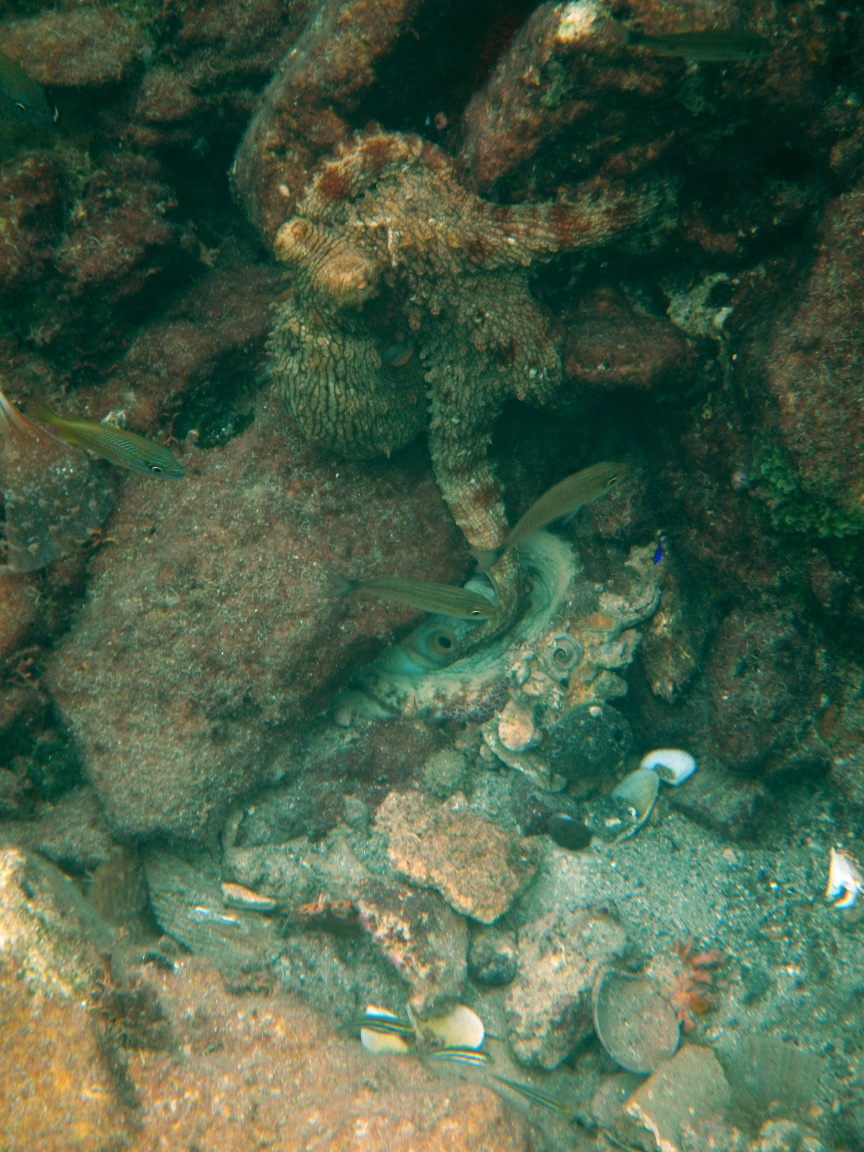
Two Octopuses Making Babies

The octopus you can see clearly is reaching his third arm into the den of female. You can see the funnel of the female. There's a fish in front of her eye. The male injects his spermatophore into the female. She decides whether and when to let it fertilize her eggs. It's a big decision. After fertilizing her eggs she never eats again. She tends the eggs and then dies.


7/7/2015

Got the chance to meet this fellow on the way up to the room last night.

Tuesday, July 7, 2015

The Big Iguana

Here is the big Iguana, sometimes seen on the path from the rooms to the beach.


Hermit Crab Shell Market

Professor Sandra Gilchrist and her students have been labeling shells and leaving them out for hermit crabs on Cayos Cochinos for fourteen years. She leaves about 6,000 shells per year for land crabs and 4,000 for sea crabs. 

This year I did my part by labeling 50 shells and creating a small market in the woods by our rooms. Hermit crabs come to market to trade their old shells for new ones. My market has seven net sales of labeled shells in two days. The pictures show today's market, nicely ordered in the morning 


and in disarray in the evening after a day of hermit crabs shopping.


Tuesday Afternoon


Thomas and Adam


Austin and Mei Jing


Carlos

Moray Eel

After dragging myself out of bed this morning and trekking down to the shore I was pleasantly surprised to see a Chainlink Moray Eel. This specimen was approximately two feet in length and was seen in a five inch crevice between two rocks. Dante, the island chef, claimed that it was his pet that was always present when fish were being cleaned. One time it launched itself onto the ground and attempted to haul a 30+ pound fish back into the water. It was ultimately unsuccessful, but to his surprise managed to move it a few inches closer before receding back into the water.

Monday, July 6, 2015

Night Swim

July 6th

         As the last of the daylight started to fade, our entire group prepared ourselves for our first night snorkel. One by one we each sat down in the water, each shocked at how cool it had become. However, that didn't phase me for too long because I was so excited to see the changes night brought to ocean life. Sophia and I both let out a little squeal as we saw our fist fish, neither of us had done anything like this before. It swam out of our field of vision too quickly to identify, but just seeing it made us both become more intrigued. We swam over to the coral hoping for a little more excitement. On the way I couldn't help but satisfy my curiosity, and I reached down to touch a nearby starfish. It was so much squishier than they were during the day, (making themselves more stiff during the day probably helps defend from enemies), and I quickly urged Sophia to touch the starfish too.  (Now starfish are my new underwater obsession.)  During our swim some other highlights were that we saw  a  Squirrelfish, Holocentrus adsensionis, which is a beautiful fish with red and white scales, and huge eyes that glimmer in the light, as well as a scorpion fish which perfectly blended in with the rubbish underneath the dock. The night swim was super cool and I can't wait to do it again.  

On a nocturnal note

Around 7 in the evening we set out on our first nighttime snorkeling adventure. We separated into groups with a designated flashlight holder and stayed within the boundaries that we were given. The species activity is completely different at night, I saw quite a few creatures that I haven't even seen during the day. It may have just been that I was trying to pay attention to things around me more closely than I usually would have because it was harder for me to see. The fish that were feeding at the bottom were much less reactant to me swimming up close to them, even with the flashlight on. I was surprised by how close I was able to get to them before they slowly began to move away.
Beaded Sea Cucumber
(Nocturnal species)

Notice feeding tentacles near bottom of photo 

Longspine Squirrelfish

Spotted Scorpionfish

Spotted Scorpionfish

Yellow Stingray

Yellow Stingray feeding near a Starfish.

Day of Relaxing, Work, and Fun

We had a very relaxed morning today. Dr. Gilchrist told us to finish up our assignments due today. After working for a solid amount of time, Sonja and I decided to set out for some kayaking. We wanted to go out for the point, but decided once again that it would be better to go to the beach near the point so that we didn't get sucked away. After paddling for a while, we finally reached the beach! We saw some very cool snails and climbed the rocks where we saw some crabs and very pretty shells. After that, we went back and gave our presentations of our focal animal and focal area sampling data (discussed in earlier people's blogs). So many people saw really cool species! I was really intrigued by how differently fish behave especially and I'm looking forward to start working on our projects this week. After eating dinner, we went for a night snorkel. We used flashlights to see underwater and we saw an octopus again! We also saw a scorpion fish, which I had never seen (or identified before). A few people got jellyfish stings and I hurt my finger on the dock, but it was definitely worth it. Sonja and I also saw a fish sleeping on turtle grass. The reefs are completely different during the night! After I was just about to go in, I came back out when I heard that a few people were seeing an eel. I put on my snorkel and Thomas showed it to me. It was so pretty and glissened on the bottom of the shallow sea floor. Great way to conclude a very nice day!

Don't be a hermit, there's plenty to explore here!

On the evening of the fourth we begun work with hermit crabs! We were instructed to separate into three groups with our roommates. Each group was given 50 of the same shells. We were to label each shell with a “T” to indicate our room followed by the shell number 1-50 and 15 at the end to indicate the year. After labeling each of the shells with sharpie we were to put a bit of superglue on the marker to seal it on shell. Then we took four measurements of each shell using calipers. We took the length and width of the shell and the length and width of the aperture. There were four students in our group and we each took one of those measurements for all 50 shells. We worked like machines and finished fairly quickly with a great deal of accuracy. After measuring the shells each group chose a location to place their shells. We placed ours in the sand to the right of the pathway leading to the water from the dining area. Each morning we are to check the shells to see if any have been taken by crabs. If any shells are left we are to take the same shell measurements to determine the approximate size of the creature. The morning after we placed the shells, July 5, there were no takers. Our group felt slightly discouraged and thought we chose a poor location. The next morning however, we had a taker! A critter left a tulip shell and moved into shell #39! The shell it moved into had an aperture of about two millimeters larger than its original shell!

We placed the shells to the right of the pathway leading to the water from the dining area. They are about four and a half meters from the shore line.
This is the first shell that was recovered. We believe that some type of snail inhabited this tulip shell.

We took measurements in millimeters. The following values were recorded:
total length 47.73
total width 18.19
aperture length 9.36
aperture width 9.12
The shell it moved into was measured in milimeters and its values were
total length 36.85
total width 14.65
aperture length 13.41
aperture width 11.44


7.5

Ah the lovely day after the 4th. I woke up alert today despite the 5 hours of sleep. No bad bug bites.

(Skip breakfast... I mean I ate... just.... anyway.)

We went out today in pairs/trios to do different types of studies on the corals. Natalie and I first did the 10 minute 1 meter by 1 meter watch. She took pictures while I recorded on a dive slate. After that, we followed a little blue tang fish around for ten minutes and watched him eat. I was able to swim with the huge fish again under the dock, and we were messing around and saw an OCTOPUS. A HUGE ONE. He clearly didn't fit in the crevace like he wanted. At first we thought he was a huge snail, and then I saw his big eyes and suctions and called Natalie back over. He was so cool! It's definitely something I hope I never forget.

(Skip lunch)

We had free work time, so I went up and took a shower in the daylight for the first time in a while. (After much anger at the water in cabin 8's shower which was so hot I was so unhappy I couldn't even touch it.) Then I've been here, at the computer, working on the Species Identification powerpoint of mine (now a lovely green and closed and done!) and attempting not to pass out next to Codee. (who braided my clean hair all nice)

At dinner, Austin and I thought it would be a good idea to pour hot sauce on our food. Of course it was super spicy hot sauce and we both were dying, but continued to eat because we had to eat something. So we both died for a while. My tongue was on fire and my lips went numb. But after a little bit more work it was alright. Then Natalie and I went back up to the room and worked more on our poster project we did today using focal species and focal area. 

Now I'm exhausted, and I need to sleep.


-- 
Olivia Van Housen

Sampling Activities

To date we have been introduced to four different sampling techniques. We were sent into the field with appropriate equipment for about an hour to complete each exercise. On July 1, 2015 our seven student group completed the point quarter transect and the regular transect on two separate expeditions.  The point quarter transect involved choosing and marking ten points two meters apart from one another. After the points had been flagged, photos were to be taken in four quadrants around each point one meter from the flag. In the regular transect at least five points were to be marked one meter apart in a straight line. In both transect exercises photos were taken of the points and students were to identify the species of coral in the area. The data was later transferred to an excel spread sheet and the percent coverage of coral was analyzed. On July 4, 2015 we worked on another type of sampling called grid sampling. This time we were to flag off a 5 meter by 5 meter square in the same location we did the transect. We were to visualize this sectioned off square as a grid with 1 meter by 1 meter sections. To start the sampling we were to pick three coordinates and take a photo in each of the sections. Our group chose (1,1), (3,3) and (5,5). This information was transferred to an excel spread sheet and the percent coverage of coral was analyzed. On July 5, 2015 we conducted focal area and focal animal sampling. Our three person group worked on the focal area sampling first. In this type of sampling researchers are to watch a single area 1 meter by 1 meter and observe the organisms that come in and out of the area. The species name, movement, and behavior was recorded for later analysis. To conduct the focal animal sampling a single animal is monitored and its behavior is recorded. Both samplings were conducted for a predetermined period of ten minutes. The information observed was used to create a poster that will be presented later on today.

Day 7: July 5

We went snorkeling this morning at 1030. In partner groups we were to do focal species and focal area field study techniques. I was grouped with Olivia. The focal species is where you choose a species to follow for ten minutes. You observe it and take pictures of it. We followed a Blue Tang fish. At first I was nervous that we would easily lose it or scare it off but it was a generally calm and easy animal to follow. He mostly fed on plants and corals and hid under rocks and swam around. It was fun. Next was the focal area. That is where you pick a small area, about 1m by 1m, and observe the habitat for ten minutes. I took pictures and Olivia wrote notes on a dive slate. The observations have been recorded on a poster like PowerPoint that we will present to the group tomorrow. In the afternoon we had time to work on our various assignments. Upcoming we have due our second essay which is to compare sponges and Portuguese Man O’ War on why sponges are animals and Portuguese Man O’ War are colonies. Also, we had to make a poster on our observations from todays field study. Also, we have to work on our newest transect and analyze the coverage in our groups. Lastly, we have to finish our species identification assignment. It was a full day of work, but I have everything under control and it feels good.


We found an octopus today after we finished our focal work!


Sunday, July 5, 2015

Day 6: July 4

In the afternoon we practiced a new field study technique called sampling. We placed flags on four corners of a 5m by 5m grid. Before we got out to the reef we decided on coordinates that we would use to take pictures of; rows and columns, each row/column being 1 m. We we got out there, we measured and took pictures of the spot. We will then analyze the photos for percent coverage of coral and compare them to our transect results to see how accurate/precise the two techniques are to each other.

After that, we got out hermit crab assignment. Each room is given 50 hermit crab shells. We are to label them based on room, number and year (the 15th shell is T1515, we are room T for top of the hill...), and we will place the shells near our rooms tonight and see where they end up in three days time. I am excited to interact with hermit crabs in a scientific sense and I have only played with them as domesticated animals. We also have to measure the length and width of the shell and aperture (opening) so we can later compare that data with the shells that the crabs discard.

our shells all lined up to be measured

Tarantula in our room

Climbed up into the rafters to see if I could find anything funky, and this "little" guy started moving about. A Honduran curlyhair tarantula.

-Thomas Chaffee

7-05-2015

This morning we went out and hunted for photos for crustaceans and fish. Of course, I was super excited to just be out in the field observing stuff. Still, the parrot fish are my favorite, so (obviously) I swam after a few of them trying to get the best "glamour shot." We went out for an hour, and then Natalie and I saw everyone else heading in. Naturally, we kept at it in stride to the other side of the dock to look for more crustaceans. SO MANY LOBSTERS. I mean... three isn't considered "many" but it's ok. (Some were just dead and cooked lobster heads.) After a lot of salt water and diving down to creep on unsuspecting urchins, we finally went inside.

(Skip lunch and hour break furiously moving 250 photos into their respective places.)

This afternoon we went out and looked for mollusks and plants to the right of the dock. Because Natalie and I had already been out there, I was able to recognise certain corals as ones I saw on the first excursion. I worked on trying to perfect my photography, and found a really odd worm. Later I will identify it... probably. 

After most of the group went inside, I still (ignoring the toe blisters from the fins) went hunting and went under the dock. It was amazing! I saw a (father) seahorse hanging on to a palm fronth and I swam with hundreds of little tiny fish. It was one of the most epic experiences I've ever had. 

-Olivia Van Housen 

7.3.15

Thursday, July 2, 2015

7/1/15 - Coconut Party

Coconut Room Service from the nicest native around. This man looks to be in his sixties and yet he can scale a coconut palm tree effortlessly. I want to be able to do this someday!